The #1 Cybersecurity Mistake Small Businesses Make
The #1 Cybersecurity Mistake Small Businesses Make
Why weak password practices and missing MFA put businesses at risk
Many small businesses assume cybercriminals only target large enterprises. Unfortunately, the opposite is often true. Smaller organizations are frequently easier targets because they lack strong cybersecurity policies. According to the Verizon Data Breach Investigations Report, 74% of breaches involve the human element, including stolen credentials and weak passwords. When simple login protections fail, attackers can gain access to entire networks in minutes.
For companies with 25–250 employees, this risk grows quickly as more employees, devices, and cloud platforms are added. The most common cybersecurity mistake small businesses make isn’t advanced hacking or sophisticated malware. It’s something far simpler: poor password policies and the lack of multi-factor authentication (MFA).
Understanding this risk is the first step toward protecting your business.
Weak Password Policies Leave the Door Open
Many businesses still rely on basic password practices that were acceptable a decade ago but are now dangerously outdated. Employees often reuse passwords across multiple systems or create easy-to-guess logins so they can remember them.
Cybercriminals know this.
Attackers regularly use automated tools that can test thousands of password combinations in seconds. If a password has already been leaked in another breach, attackers can use it to access email accounts, business software, or cloud platforms.
Common password risks include:
- Employees reusing the same password across systems
- Short or simple passwords that are easy to crack
- Shared logins between team members
- Lack of regular password updates
- No centralized password policy enforcement
According to Microsoft security research, more than 99.9% of compromised accounts did not use multi-factor authentication. That statistic highlights how simple security controls could prevent most attacks before they start.
Without strong password policies, even a small mistake by one employee can expose an entire company’s data.
Why Multi-Factor Authentication Is Essential
Multi-factor authentication (MFA) adds an additional layer of protection beyond a password. Even if an attacker steals login credentials, MFA requires another verification step before access is granted.
This might include:
- A mobile authentication app
- A one-time code sent to a device
- Biometric verification
- A hardware security key
For businesses relying on cloud solutions like Microsoft 365, CRM platforms, or accounting software, MFA is one of the most effective cybersecurity defenses available. It significantly reduces the risk of account takeover attacks, ransomware incidents, and data breaches.
However, many small organizations delay implementing MFA because they believe it will be difficult for employees or disruptive to workflows. In reality, modern authentication tools are easy to deploy and typically take seconds for users to complete.
This is where managed IT services can make a significant difference. An experienced IT provider can implement secure password policies, enforce MFA across systems, and monitor for suspicious login activity — all without creating friction for employees.
For growing companies, this kind of proactive IT support is critical for protecting sensitive data, maintaining compliance, and ensuring reliable small business technology infrastructure.
Strengthen Your Security Before It Becomes a Problem
Cybersecurity incidents rarely start with complex hacking. Most begin with a stolen password or a compromised login.
The good news is that this risk is highly preventable.
Businesses can dramatically improve protection by:
- Enforcing strong password policies
- Implementing MFA across all systems
- Monitoring account activity for unusual behavior
- Partnering with experts who specialize in cybersecurity and cloud solutions
Working with a trusted provider of managed IT services ensures these protections are properly configured and continuously monitored.
If your organization is unsure whether your current security practices are strong enough, the team at Nerdworks Services can help. Their experts specialize in helping companies strengthen cybersecurity, improve IT support, and protect critical systems before problems occur.
Learn more or request a consultation athttps://nerdworks.services.
Sources
Verizon. 2024 Data Breach Investigations Report.https://www.verizon.com/business/resources/reports/dbir/
Microsoft Security. Your Pa$$word Doesn’t Matter.https://www.microsoft.com/security/blog
Gartner. Market Guide for Managed IT Services.https://www.gartner.com
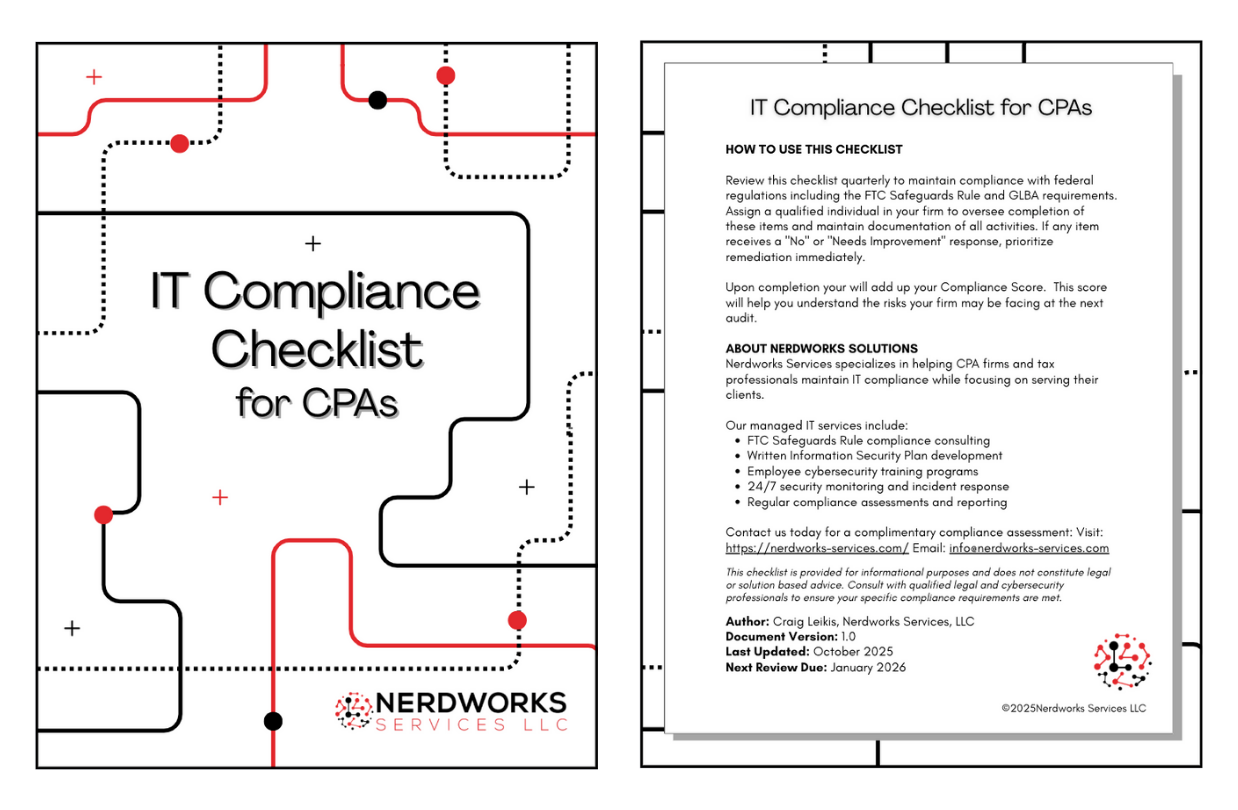
**To help you stay compliant,**we have created the IT Compliance Checklist for CPAs. This is the comprehensive checklist you need to identify issues, fix them, and build compliance BEFORE your next audit.
If you have any questions or need further explanation, this checklist comes with a 30 minute consult to personalize this checklist to your firm.
STAYING COMPLIANT -IT Compliance Checklist for CPAs
Nerdworks Services, LLCspecializes in helping accounting firms and other compliance-driven companies navigate remote work’s complexities while maintaining compliance and supervision standards through collaborative consulting, infrastructure design, IT management, training, and ongoing support.
Nerdworks Services, LLC| 1901 Central Drive, Suite 401, Bedford, Texas 76021 | (682) 324-9360 | website:https://nerdworks.services/ email:[email protected]


