
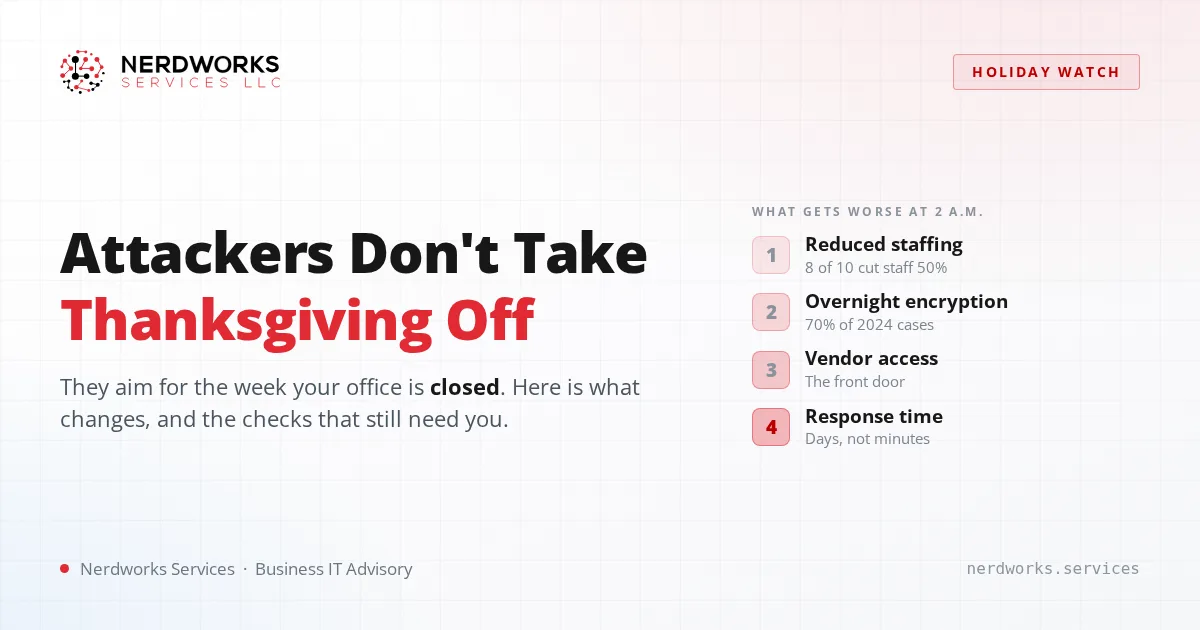
Attackers Don't Take Thanksgiving Off: Why This Is Their Favourite Week of the Year
Attackers don’t take Thanksgiving off.
The instinct is that a holiday week is a slow week — fewer customers, fewer calls, a firm running on a skeleton crew. For most businesses, that is exactly right. For the people breaking into networks, it is the most attractive week of the year, and it has been for a long time.
In August 2021, the FBI and CISA issued a joint advisory because of what they were seeing: “an increase in highly impactful ransomware attacks occurring on holidays and weekends — when offices are normally closed.” Their examples were not hypothetical.
Over Mother’s Day weekend in May 2021, DarkSide took the IT network of a critical infrastructure entity in the US energy sector and the result was a week-long suspension of operations. Over Memorial Day weekend that same month, Sodinokibi/REvil hit food and agricultural entities in the US and Australia, producing a complete production stoppage. Over the Fourth of July, REvil went through a remote monitoring and management tool used by IT providers, affecting hundreds of organizations — including multiple managed service providers and their customers.
Read the advisory’s wording precisely, because it is more precise than the summaries usually are. The FBI and CISA observed “an increase in highly impactful ransomware attacks occurring on holidays and weekends.” They said highly impactful — not an increase in the total number of attacks. The attacks that land on a holiday are the ones that get to finish, because nobody is watching to interrupt them. The increase is in what completes, not in what starts.
That last example is the one that should stick with a small firm, because it says something specific. The holiday attack often does not come at you. It comes through the backup tool, the remote support app, the accounting system your bookkeeper connected once years ago. It comes through the vendor.
The short version, if you only read one thing
- Holiday timing is a choice, and it is made by the attacker. More than half of all ransomware attacks over a recent twelve-month window happened over a holiday or weekend, according to a Semperis study of 1,500 IT and security professionals.
- It is not that more attacks start in December. Google Threat Intelligence Group's own data shows attack volume is roughly flat — what changes is the timing. Attackers encrypt overnight and on weekends, when the least number of people are awake to interrupt them.
- What does grow is the attackers' supply. Seasonal lures, stolen credentials, and tooling are all up sharply this year. That is ammunition being stocked, not a firing rate increasing — and it means your staff should expect more seasonal-themed lures in the inbox than ever, aimed at the way your firm moves money.
- The FBI published ten specific actions for this exact problem in 2026 under Operation Winter SHIELD. They are not complicated. Most of them take an afternoon.
- You can hand us the watching. You cannot hand us the MFA, the backup test, and the phone number you would call at 2 a.m. on Thursday. The five-item list below is still yours, and it is what makes the difference between a bad night and a bad quarter.
The Number That Explains the Timing
Semperis, working with Censuswide, surveyed 1,500 IT and security leaders across North America, the UK, Europe, and Asia-Pacific. The finding that gets quoted is the headline one: more than half of all ransomware attacks in the previous twelve months took place over a holiday or weekend.
Hold onto the word “more than half” for a second, because it is easy to misread. Holidays and weekends are roughly a third of the calendar — 104 weekend days plus about a dozen federal holidays out of 365. So if attacks were spread evenly, about a third of them would land on a holiday or weekend. More than half means the concentration runs at roughly twice the rate chance would predict. That is not a spike — a spike would mean the year’s total attacks piling into a five-day window, which is impossible. It is the same number of attacks, redistributed.
The supporting number is the one that matters for a firm your size. Eight out of ten organizations reduce staffing by 50% or more during weekends and holiday periods. Matt Brady, a senior principal researcher with Unit 42 at Palo Alto Networks, put it plainly: “During the holiday season, we know that most security teams are operating with reduced staff. Unfortunately, cyber criminals are fully aware of this and they actively look to exploit those reduced coverage periods.”
Read those two numbers together and you have the whole attacker’s business model. They are not trying to break in more during the holidays. They are trying to break in during the window where your response time is measured in days instead of minutes — and where nobody interrupts them halfway.
It Is Not That More Attacks Start — It Is That More of Them Finish
There is a version of this story that overstates the case, and it is worth correcting before you spend money on the wrong problem.
Zach Riddle, a principal analyst with Google’s Threat Intelligence Group, has been pulling leaked chat logs from ransomware crews. His finding is that December activity does not surge the way people assume — some groups literally take time off between Christmas Eve and the Russian Orthodox holiday in mid-January. What crews do instead is aim the attack at the quiet hours. In 2024, hackers encrypted data between 6 p.m. and 8 a.m. in more than 70% of the cases Google responded to, and in 30% of cases encryption began on a weekend.
His explanation is the practical one: “Conducting encryption during non-working hours may allow threat actors more time to complete their operation before the victim is able to identify and react to the incident.”
So the accurate framing is not “more attacks in December.” It is the same attacks, deliberately placed where nobody is watching — and a holiday week is where they are least likely to be interrupted. A monitoring stack that alerts a human at 3 p.m. is worth a great deal. A monitoring stack that alerts a human at 3 p.m. and then nobody opens the ticket until the following Tuesday is worth much less than the invoice suggests.
This is also why the recovery gap, not the breach, is what damages a small firm. The intrusion might be ninety seconds of work. The four days of not noticing is what turns it into a ransom demand.
What the Holiday Window Actually Looks Like
Before the specifics, one distinction that keeps the rest of this post honest.
Three different things get called “volume,” and only one of them is the number of attacks aimed at you:
- Attempts landing on your business — roughly flat
- Lures, stolen credentials, and tooling available to attackers — sharply up
- Attention available to you and your staff — sharply down
The middle one is the one that shows up in vendor reporting, and it is the one most holiday-security articles mistake for the first. What FortiGuard measured was the attacker’s supply — the ammunition, not the firing rate.
The seasonal lure economy is much bigger this year. FortiGuard Labs tracked more than 18,000 holiday-themed domains registered in a single three-month window — Christmas, Black Friday, Flash Sale — with at least 750 confirmed malicious. Alongside those, more than 19,000 domains imitating major retail brands were registered, 2,900 of them malicious. These support phishing, fraudulent storefronts, gift card scams, payment harvesting, and SEO poisoning that pushes malicious URLs up in search results when people are shopping quickly.
Read that carefully, though. Those numbers describe the consumer and e-commerce threat surface — the shoppers and the stores. A twelve-person accounting firm does not run a Magento checkout that can be payment-skimmed. What the number actually predicts for you is narrower and still useful: expect more seasonal-themed lures arriving in your inbox this year than any year before, because the tooling to build them is cheap, automated, and stocked. More seasonal spam is a supply-side consequence, not evidence that more crews are coming for you.
Credentials are abundant. Fortinet also found more than 1.57 million login accounts tied to major e-commerce sites available through stealer logs across underground markets in a three-month window. Stealer logs hold browser-stored passwords, cookies, session tokens, and autofill data. The holiday makes them more valuable, because people log into more accounts, on more devices, with fewer thoughts about it. Again, this is supply: more real credentials in circulation, more of them harvested from people who were also doing their holiday shopping on the same laptop.
Business email compromise does not care what day it is. The FBI’s 2025 Internet Crime Report — released in April 2026 — recorded 1,008,597 complaints and nearly $21 billion in reported losses. Phishing and spoofing, extortion, and investment schemes were the most reported complaint types. Compromised corporate email accounts were named as one of the costliest tactics, and the report noted that complaints involving AI-assisted fraud — fake social profiles, voice clones, forged identification documents, believable videos of public figures and loved ones — accounted for 22,364 complaints and nearly $893 million in losses.
Those are annual figures, which is the point: BEC does not have a holiday spike. It is the same all year, and it lands on your business whenever it lands. What the holiday changes is not whether the attempt comes — it is how long it sits in your inbox before anyone sees it.
That last detail changes how you should think about the phone call. A holiday week is when a family member might ask you to send gift cards, and a voice on the phone may not be the voice you think it is.
The phishing that targets you specifically does not look like consumer phishing. It looks like a vendor invoice that came in wrong, an accountant asking for a gift card, a “quick question about the closing documents,” a password reset you did not request, or a package notification for a thing you never ordered. The seasonal lure economy is aimed at consumers; the lures that reach your firm are aimed at the way your firm moves money and files documents — and they are aimed at it on schedule, whether or not anyone is at a desk.
What the FBI Says You Should Do About It
The FBI’s Operation Winter SHIELD, launched in 2026, distils ten actions that it says make the largest difference to resilience. This is not a vendor list. It is the FBI’s own distillation of what its investigations showed defenders were missing. Condensed to the ones that matter in a holiday window:
Adopt phish-resistant authentication. The FBI’s advice is specific: prioritise administrators and executives first, use FIDO2 security keys or device-bound passkeys, require number-matching and domain display if you use an authenticator app, avoid push-only approvals, and eliminate SMS-based multi-factor entirely.
Keep offline, immutable backups and test the restoration. The 3-2-1 rule — three copies, two media types, one offline and immutable. Backups are among the first things ransomware touches, so isolation and a tested restore are the plan, not the copy.
Protect your logs and keep them. Centralise authentication, email, endpoint, network, DNS, remote access, and cloud audit logs, export them daily to protected storage, and treat twelve months as a common baseline. Adversaries try to erase them. If yours are gone, you cannot prove what happened.
Inventory and protect what faces the internet. Remove unnecessary exposure, require authenticated gateways, disable direct internet-facing remote desktop, and scan your public address space for new exposures.
Publish and enforce DMARC, SPF, and DKIM. Email is still the favourite way in. Move DMARC from monitoring to quarantine to reject as alignment matures.
Reduce administrator privileges. Fewer admin accounts, no standing local admin on user devices, just-in-time elevation, and alerts on privilege changes and new admin accounts.
Track and retire end-of-life technology on a defined schedule. Unsupported systems are routinely targeted because they will never be patched.
Exercise your incident response plan. A sixty-minute tabletop, quarterly, with technical, legal, communications, operations, and leadership in the room — and your local FBI field office contact in the plan.
Manage third-party risk. One list, with named owners, of every vendor that has access or handles data. Require strong authentication and least-privilege access, audit for unused accounts, require rapid breach notification contractually, and revoke access when a contract ends.
Run a risk-based vulnerability management programme. An asset inventory with owners and business criticality, remediation timelines based on risk rather than on CVSS score alone, and documented exceptions that carry compensating controls and fixed completion dates.
One more line from the FBI is worth repeating out loud: the Bureau and CISA both strongly discourage paying a ransom. Payment does not guarantee recovery, and it funds the next one. Report it to IC3 and to your local FBI field office.
The Part You Cannot Delegate
Here is the honest part. We are good at the watching. We are not good at the deciding.
Monitoring, endpoint detection, backup verification, patch management, vendor credential reviews, log retention — those are the things a managed service provider can carry for you, and they are the things that are genuinely hard to do well with two people and a busy December. When something fires at 11:40 p.m. on the Thursday after Thanksgiving, somebody should be awake who is not you.
But five things stay with the business, no matter who else is on the phone. These are the ones we will ask you about, and the ones that decide whether a bad night stays a bad night:
-
Can we restore from backup — have you tested it? Not “the backup job reported success.” A restore, into a clean environment, with somebody watching the clock. If nobody can say how long a restore takes, you do not have a recovery plan, you have a hope.
-
Do we know who we call at 2 a.m. on Thursday? Write the number down. Put it somewhere that is not in your head. The most common failure we see is not a bad decision; it is nobody being certain whose decision to make.
-
Is multi-factor authentication actually on for email, remote access, and the administrator accounts? And is it still the push-to-approve version that an attacker can fatigue you into approving? Push-only is not authentication. It is a request.
-
Is the front door closed? No direct internet-facing remote desktop. VPN with MFA for anything remote. Vendor access for services you stopped using removed, not just unused.
-
Does anybody know what changed over the holiday? A clean baseline going into Thursday means the first odd thing on Monday morning is obvious. Without one, “was that always like that?” becomes a two-day argument.
Everything else — the alerting, the containment, the log review, the credential checks, the patching window — that is the job you are paying us to do, and it is the job we will be doing.
What We Are Doing While You Are Away
For clients on our managed services, the holiday window does not change our operating rhythm. Monitoring and support stay up around the clock. Backups keep running and keep being verified. Endpoint detection stays deployed and policies stay enforced. Vendor applications connected to your tenant get reviewed and credentials get rotated on a schedule rather than when something goes wrong.
We will also be watching for the specific shape of a holiday intrusion — the overnight encryption pattern, the mass file modification, the outbound connection to a host nobody recognises — and we will know what your systems looked like before it started, which is the only way to tell the difference between a Tuesday problem and a Thursday problem.
We will be honest about the limit of that. Monitoring finds things. It does not grant MFA, replace a tested restore, or decide who picks up the phone at 2 a.m. That is why we still make the five-item list above.
If You Want the Watching Handled
If your firm is not already covered for overnight monitoring, backup verification, and a defined response path, this is the week to fix that — before the week it is needed.
Book a free discovery call and we will look at what you are running, what has access to what, and where the gaps are. No obligation, and no jargon.
Or start with the five-item list on your own. It takes an afternoon, and it is the difference between an incident you recover from and an incident you explain to a client.
Nerdworks Services, LLC | 1901 Central Drive, Suite 401, Bedford, Texas 76021 | (682) 324-9360 | website: https://nerdworks.services/ | email: [email protected]
Sources
- CISA — Ransomware Awareness for Holidays and Weekends (AA21-243A)
- FBI — Operation Winter SHIELD: Ten Actions to Improve Cyber Resilience
- FBI — 2025 Internet Crime Report announcement
- Cybersecurity Dive — Thanksgiving holiday weekend kicks off heightened threat environment
- FortiGuard Labs — Cyberthreats Targeting the 2025 Holiday Season


